
What a Technician Sees on This Call
This is one of the most common service calls that comes in once the weather starts turning here. A homeowner presses the remote, the door starts down, gets partway, then rolls back up on its own. Or it won't even attempt to close — it just sits there while the opener light blinks a set number of times. Usually the owner has already tried the remote a few more times, maybe unplugged the opener and plugged it back in, and gotten nowhere. By the time a technician walks up the driveway, they're already thinking through a short list of causes in a specific order, because most of these calls turn out to be one of two or three things, not a dead opener.
Check the Safety Sensors First
The first thing any technician checks is the pair of photo-eye sensors mounted a few inches off the floor on each side of the track. If their invisible beam is broken, blocked, or even just slightly misaligned, the opener will refuse to close the door or will reverse it mid-travel as a safety measure — that's exactly what they're designed to do. In this area, fall brings a few specific culprits: condensation fogging the sensor lenses on cold mornings, spiderwebs and dust built up over summer, and brackets that have been bumped out of alignment by a bike, a rake, or a stored snowblower. The fix here is usually simple — wipe the lenses, nudge the brackets until both small indicator lights glow steady instead of flickering, and clear anything sitting in the beam path. If the wiring to a sensor has been nicked or chewed, that's a quick wire repair or sensor replacement, not a big job.
Look for Obstructions and Track Damage
If the sensors check out clean, the next stop is the track itself. A door that reverses at the same spot every time, rather than randomly, often means something physical is in the way — a bent section of track, a buildup of debris, or in winter, ice that's formed where runoff drips and refreezes near the bottom of the track. Road salt tracked in on vehicle tires doesn't help either; over a winter or two it contributes to rust and pitting on tracks and rollers, which changes how smoothly the door rides. A technician will run the door manually (disconnected from the opener) to feel for rough spots, then check the tracks are plumb and properly spaced. Minor bends can sometimes be worked back into shape; more significant damage means a section of track gets replaced.
Worn Rollers and Hinges Add Resistance
Next comes the rollers and hinges. As nylon rollers wear or steel ones lose their lubrication, they add friction to the door's travel. The opener's force sensor reads that resistance as an obstruction and reverses the door to protect against it the same way it would for a stray object. This tends to show up more noticeably in cold weather, when grease and lubricant thicken and metal parts contract slightly. The fix is straightforward maintenance: cleaning old grime off the tracks, lubricating rollers and hinges with a garage-door-specific lubricant (not WD-40, which washes out too fast), and replacing rollers that are cracked, flat-spotted, or more than a decade old.
Weak or Unbalanced Springs
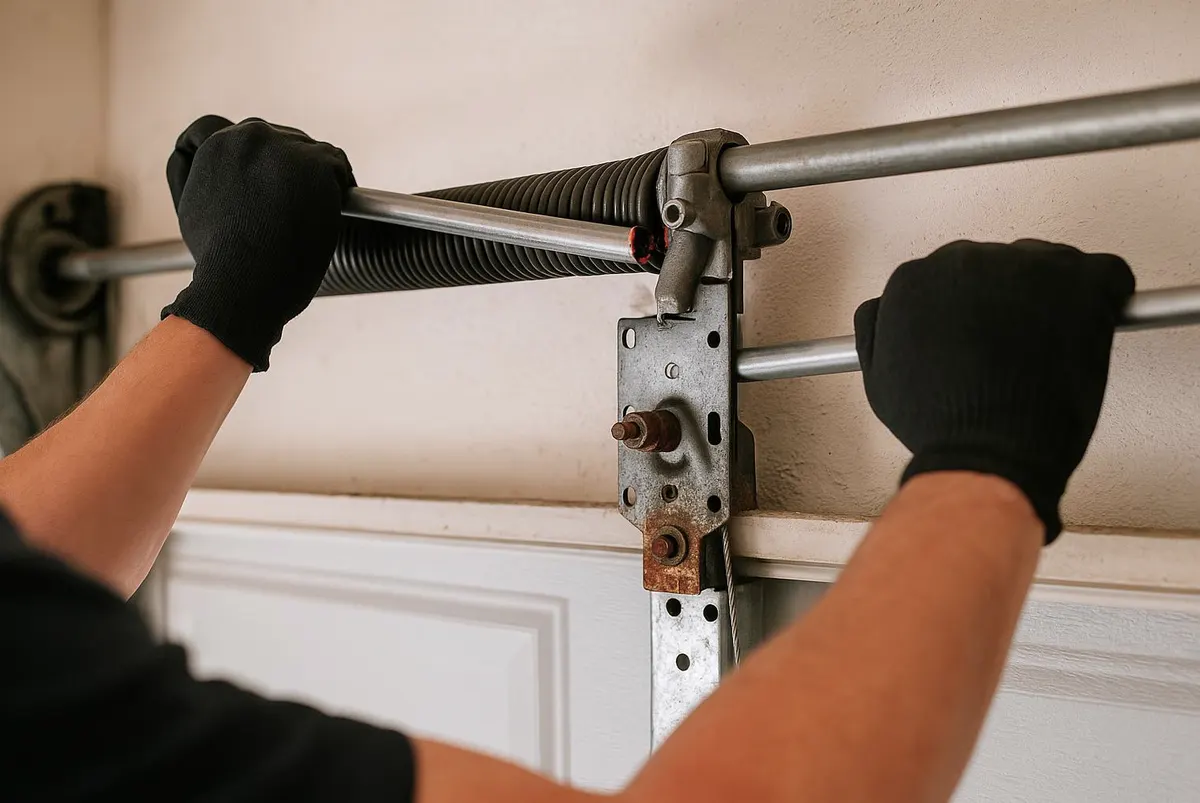
If the door still won't close smoothly after sensors, tracks, and rollers have been ruled out, the springs come under suspicion. A door with weakening springs has to work harder to lift and lower itself, and the opener compensates by pushing past its comfortable force threshold — which again can trigger a safety reversal. Cold snaps don't cause spring failure on their own, but they do reveal springs that were already near the end of their life, since cold metal is stiffer and less forgiving. A technician checks spring balance by disconnecting the opener and lifting the door by hand; if it doesn't stay roughly level on its own, the springs need attention. This isn't a DIY repair — torsion springs are under serious tension and require the right bars and experience to replace safely.
Opener Limit and Force Settings
If the hardware is sound, the next check is the opener's limit and force settings. These tell the opener how far to travel and how much resistance to tolerate before reversing. Settings can drift over time, especially after a battery backup event, a power outage, or seasonal temperature swings that change how the door moves. Adjusting these is a quick in-panel fix on most modern openers.
Aging Logic Boards and Circuit Failures
Last on the list, because it's the least common cause, is the opener's logic board itself. On openers that are older or have been through repeated power surges, the circuitry that reads the sensors and force settings can fail or behave erratically, causing reversals with no mechanical cause at all. At that point, replacing the logic board or the opener is usually more practical than continuing to chase the symptom.
When to Call Middleville Garage Door
If you've cleaned the sensors and the door is still reversing or won't close, it's worth getting a technician out before the hardware wears further or someone forces the door by hand. Middleville Garage Door handles both garage door repair and spring replacement calls like this throughout the week, and a service visit walks through sensors, tracks, rollers, springs, and opener settings in that order until the real cause is found and fixed — not just reset.
If your garage door is reversing, stalling, or refusing to close, call Middleville Garage Door for a straightforward diagnosis and repair, serving Middleville, MI and the surrounding Barry County communities.